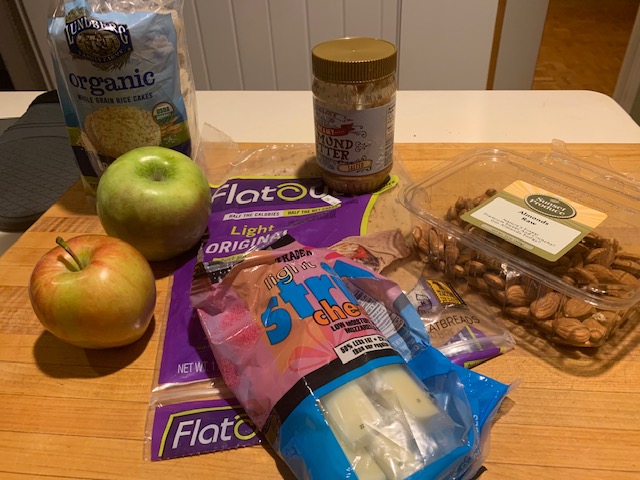
…when your seventeen year-old starts complaining that there aren’t any healthy snacks in the house, so you tell him you’re going grocery shopping and are taking requests for healthy snacks, and then he doesn’t suggest any, and then you come home after school and invite him to come shop with you so he can find the healthy snacks that he can eat because you don’t have anything to eat in the house, and then he comes with you to the grocery store to go shopping for healthy snacks because he needs to see for himself what he actually wants, and then the first thing he puts in the basket is literally something that we already have in the house, and then he asks his friend who he’s face-timing in the grocery store because he’s seventeen what kinds of healthy snacks he likes and his friend suggests something else that we have in the house, and then your seventeen year-old proceeds to walk up and down aisles suggesting all of the things that you currently have in your pantry and freezer and fridge and storage and so you leave with pretty much nothing in your cart except the stuff you originally had on your shopping list?
…no…?
yeah, me neither.
The snacks in question. Clearly I am trying to starve someone out.
Guess what brave things I did today? a) I got out of my bed b) I committed to working out – and did c) I announced that I wasn’t cooking dinner tonight d) All of the above
Of course, there was something I didn’t do today, and I’m not sure if it’s because I’m wise, or because I was just plain chicken.
There I was, waiting for an ice cream order at our local spot. The place usually gets quite a crowd, and from what I’ve seen, most folks try and manage pretty well to give others space and follow social distancing rules.
But then I saw them. A group of about 8 or 10 upper elementary-aged kids crowded around a picnic table, no space, no masks, sharing fries and food here and there. There were about 4-5 dads nearby, from what I could tell.
Those random guys could have been MY students. Or of any of my other local colleagues who have to go in to school to teach them in person tomorrow.
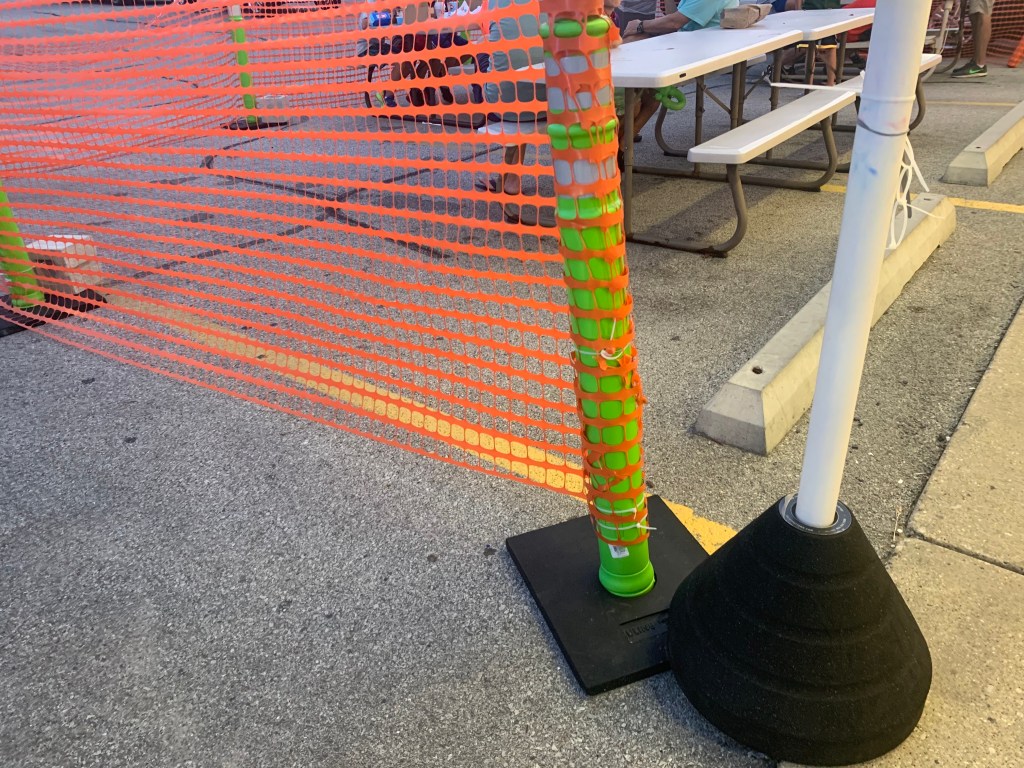
A photo NOT of the folks I saw, because that’s how I roll. #WeGoHigh
It was really hard for me to see that.
It was REALLY hard – physically hard – for me to see that, and not say something to that group.
Because I didn’t want to be THAT person.
Still, I did have the time to imagine a speech in my head:
“Hi there. Listen, I’m not trying to raise a scene. I don’t want to start an argument with you or anyone. It’s actually really hard right now for me to speak. But there’s something I need you to know.
“I’m a teacher. My school leaders, colleagues and I spent our summer preparing for the logistics of an in-person return to school this fall. We have spent even more time lying awake at night anxious about our safety, about the safety of our families, and about the safety of our school community.
“I don’t expect anything from you, but I just need you to know that it’s really hard for me to see your group together, knowing how much we we do to keep kids safe while they’re in our care, and knowing how hard we work to keep our end of the bargain.
“And I just need you to hear that if I knew my own students were out doing this same thing, and perhaps putting classmates or other teachers at risk, I’d be heartbroken.
“Again, I don’t expect anything from you. I just…needed you to hear me.”
Then my ice cream came. I decided that I didn’t wind up saying anything to the group because: a) I didn’t want my ice cream to melt b) I’m not super into guilt trips c) I’m not sure I’d actually have been heard d) I didn’t trust myself to speak sincerely and without judgement or anger e) All of the above
Instead, I took this evening as an opportunity to remember: a) I can only control me b) Emotions, even negative ones, are perfectly okay to feel c) There is power in letting go d) Sometimes ice cream really can fix things e) All of the above
this post is dedicated to A.H., whose cleverness and sincerity make me deeply proud to know such wonderful people
I’m easy to please.
Which is good, because as a teacher and as a mom, I can’t wait for big grand gestures to bring me a sense of satisfaction or well-being. I’d be here all day.
No, joy comes to me in small pockets: -The sounds of cicadas humming -A dog who insists on curling up at my feet because I’m her person -A plate of scrambled eggs and toast on a hard day
And what filled my heart to bursting today?
Some of you who have read my posts before know that I’ve been pen pals with some of my loveys. It’s been a wonderful way to stay connected during a difficult time. I started with about a dozen or so, then it trickled down to correspondence with about five kids by the time school ended. Summer…not so much.
Lo and behold, one of my former students has continued to write to me. What a joy it was to receive her letter and read it today.
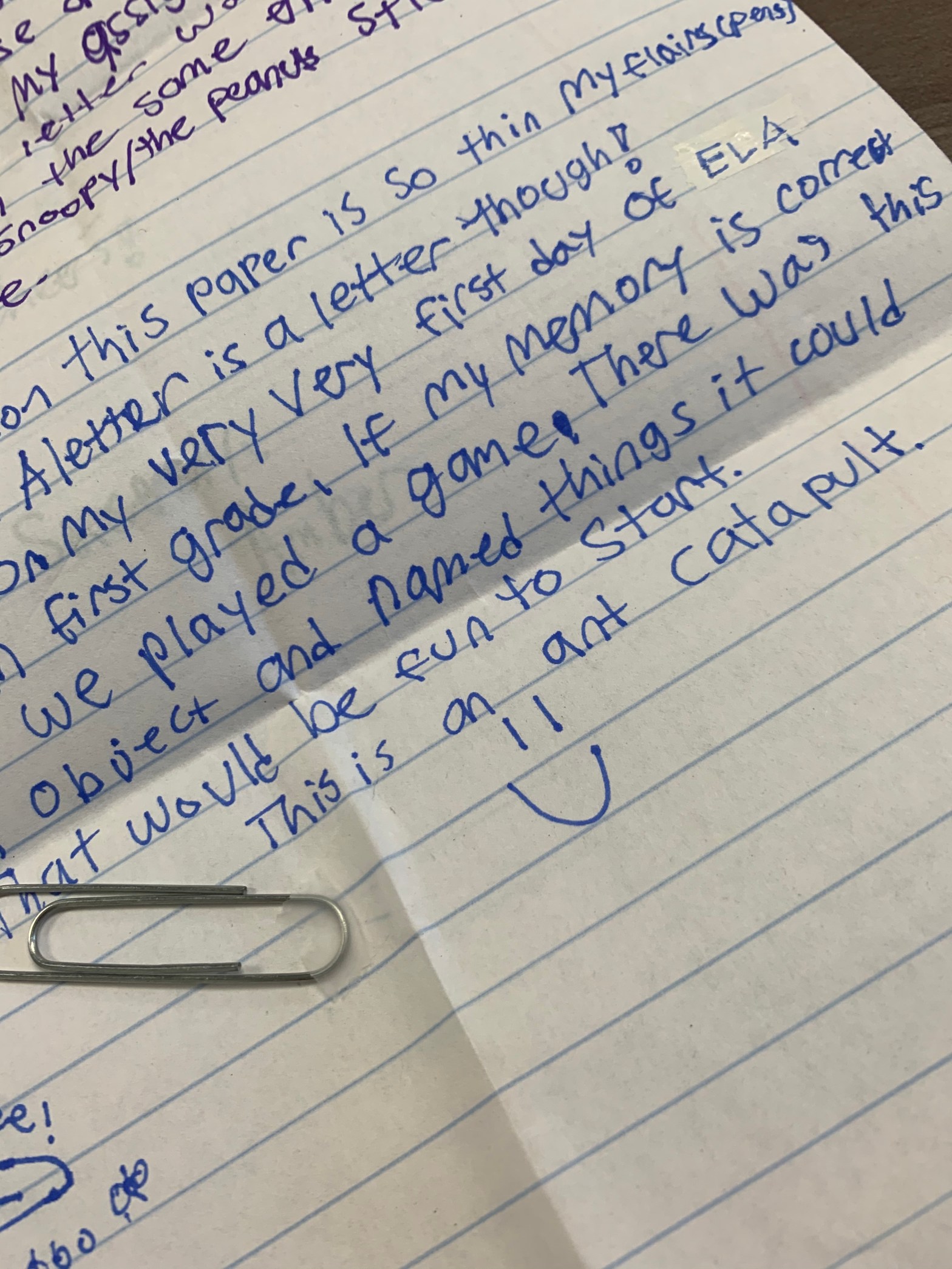
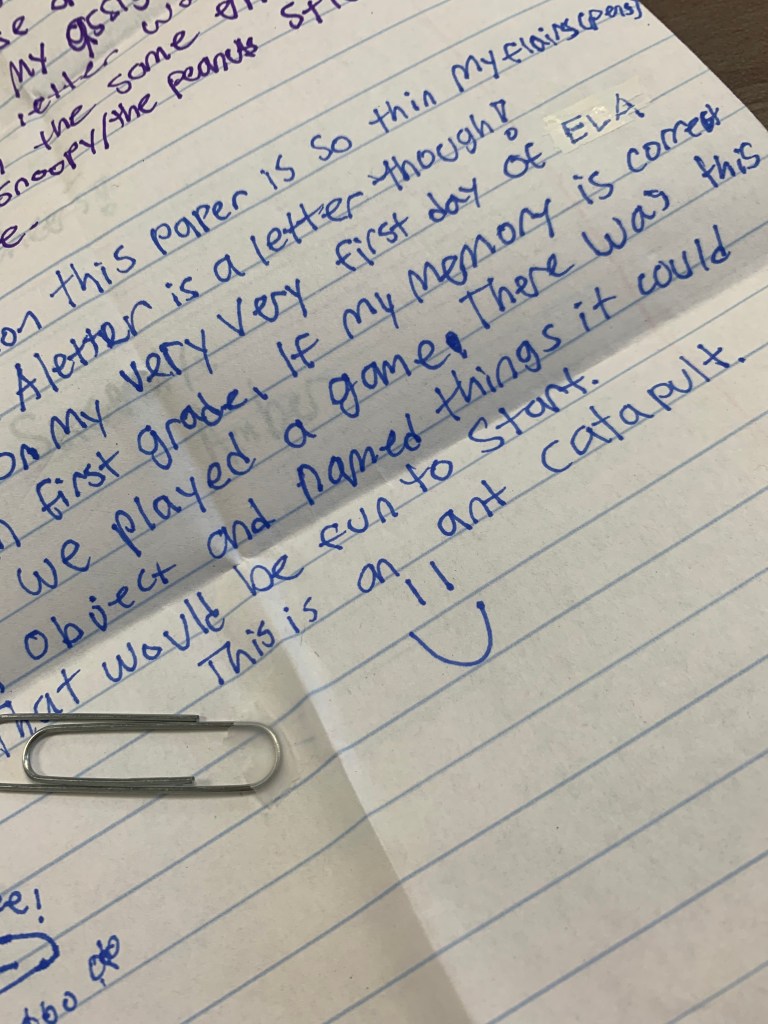
I was most excited that my pen pal letter today contained this:
“This [paper clip] is an ant catapult”
It’s an invitation to play the game “What is This?”
You see, way back when, about five years ago, on the very first day of our group, I introduced a game to this girl and her friends. The game has been around, but I don’t know its actual name. I call it “What is This?” Here’s how to play: -Start with an ordinary object (toothpick, pencil, scissors, roll of tape). -The “starter” holds the object. -Someone asks the “starter” what it is. “What is this?” -The starter says EXACTLY what it is – “This is a _______ ,” then hands it off. -The next person says, “No, it’s not a ____. It’s (makes up some imaginative idea for what it could be).” -The object gets passed and re-branded throughout the group.
One rule is that the object has to possibly be used for that purpose, even if it’s silly. I could pretend a pencil is anything – a rocket ship, a pizza, a computer. But that’s not what this game is about. This game forces me to look at form and function. At shape and material. That pencil really could be a baseball bat for a rabbit. A back scratcher. A dart. A nose picker.
Every day, we as teachers do activities for fun, for enjoyment, for learning, never quite knowing what kids carry with them. We don’t often get the privilege of finding out what our loveys remember from our time together. Yet here is one of my kids, thoughtful and creative enough to remember this game and figure out how to start up a round together even though we’re apart.
It’s quite possibly one of the cleverest ideas I’ve seen in a long time, and I’m still smiling about it.
In case you’re wondering, the answer is yes. I took that paper clip, taped it on to my own letter, and I wrote my response.
Are you feeling creative? Do you have something else this paper clip could be? I’d love to see it below in the comments.
And yet, all of that change has only served to highlight the things that remain steadfast and sure.
It is 8:00 pm on the first day of school with children in attendance.
I am exhausted.
So much about today was different, foreign, awkward:
Lining the kiddos up along 6-foot spaced dots
Seeing all my loveys from the face masks up
Slow traffic into the building as kids hand-san on the way in
Kids staying in their room for recess. For lunch. For art. For music.
Its strange and eerie how all of our back-to-school videos and pep talks are all about social distancing and mask wearing and hand-washing.
It’s sad that after years of pursuing a “less me, more you” approach to student-centered learning, we are now in the midst of a structure that requires so much more teacher-centric direction. It’s not best practice as we know it, and I’m not sure what to do with all of that. I mourn this loss.
Amid all of this strangeness that’s alternately saddening and discouraging, what is it that remains steadfast and true? Here’s a start:
My cheeks were still sore this morning from smiling at all of the kids and families as I greeted them on their way in to school.
My colleagues were right back on their game, starting right in with get-to-know-you activities and routines.
Kids still came in at all the many levels of excitement and nervousness, with all of the honeymoon-like behavior that accompanies the first days of school.
But here’s what’s at the heart of things. Here’s a tiny bit of what makes me confident that we’ll be okay this year, despite everything being turned upside down.
If anything, this situation has more firmly committed us to the belief that our work is 90% social and emotional. Only when we take care of the humans in front of us can we begin the work of academics. This year gives us the permission to live that philosophy in truth.
Even though the world conspires to rob us of community (social distancing, masks, decreased interaction, remote learning, lack of human contact), my colleagues and I will STILL manage to create caring, tight-knit bonds because that is our superpower. That is what we do.
It’s what we always do.
It’s why teaching is our calling.
It’s what’s going to get us through what promises to be the most difficult year of our careers.
Every year since my older guy started kindergarten, I’ve brought my kids to the local breakfast place for a traditional first-day breakfast. Over the years, we’ve toggled it a bit. For a while, I worked in the same district they attended, and our annual ritual celebrated a beginning for all three of us.
In later years, when I took a different position, I was often into my school year before my kids were, but we still continued our custom.
Even when my older son started college last year, I was beyond pleased when he asked to do a breakfast together on his last full day in town. It marked the transition to doing two separate first-day breakfasts to commemorate the year for each guy.
And this year? I wouldn’t swap the tradition for the world. So maybe we still have to do two different breakfast dates. So maybe I’m still nervous about eating at restaurants. So maybe we have to bring home food in a paper bag because that’s our pick this time around. So maybe we eat side by side on the family room sofa instead of at our booth at the cafe.
So what.
There is so very, very much about this year that is so different, so strange, so foreign.
And yet, all of that change has only served to highlight the things that remain steadfast and sure.
Tomorrow’s post will be about exactly that – what emerges as right and true for me as a teacher, even in the midst of this difficult world.
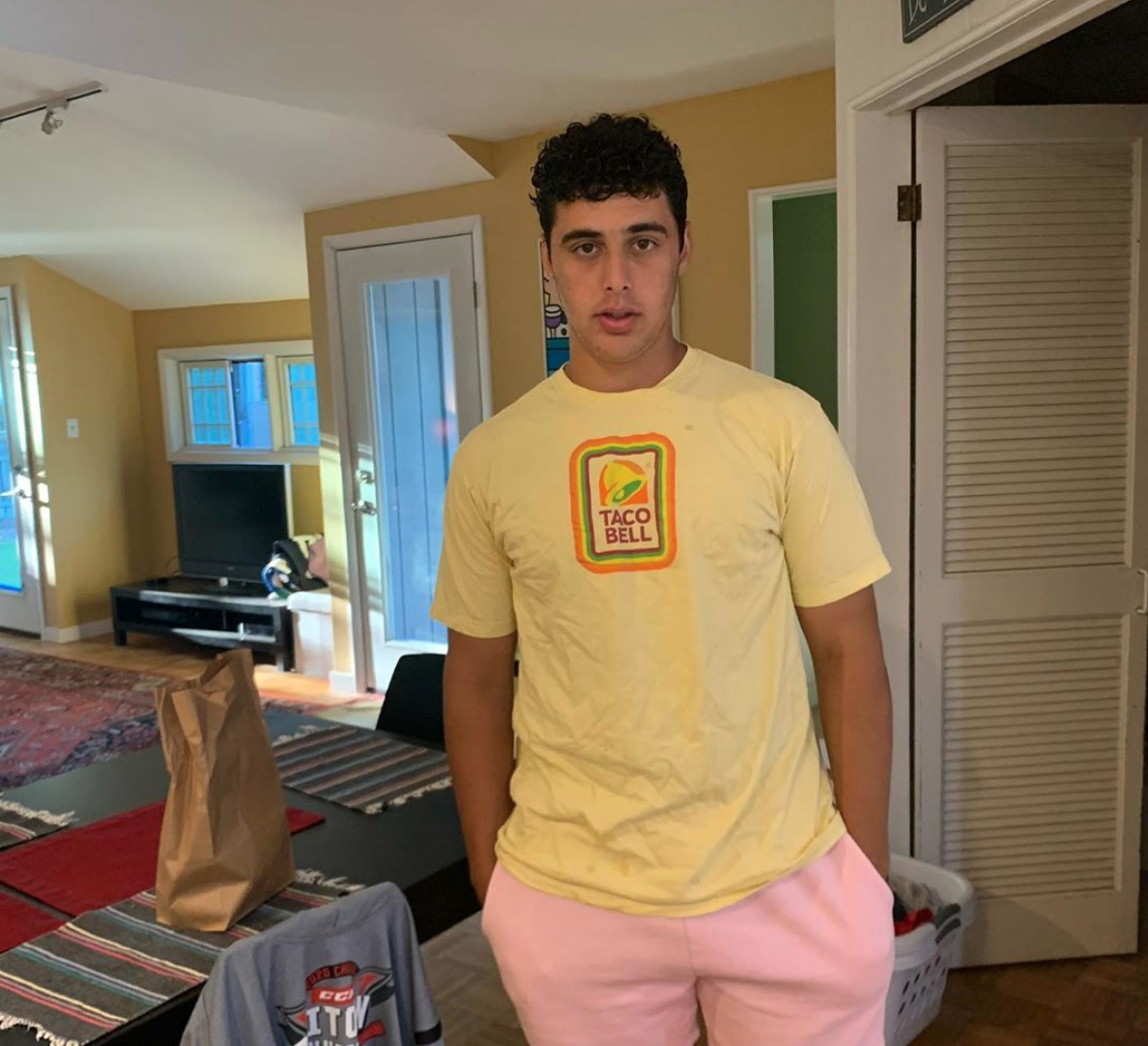
Until then, I’ll smile to myself knowing I have another first day in the books, and knowing that I was able to coax one. More. Photo. Out of a reluctant teen who would rather roll his eyes than take a photo for Mom.
*this post is dedicated to J.O., who never ceases to inspire me, and who also reminds me how important it is to be the best version of myself*
Here I am, back after what is way too long a hiatus from writing.
What’s kept me?
Inertia, pure and simple. I wasn’t in a space or place to do the digging I needed to do as a writer. Maybe that means that I saw work, turned tail and ran away. Or maybe it means that I chose a model of self-preservation that allowed me some grace.
Potato, potahto.
So…what’s brought me back?
Let’s start with a letter a student wrote me.
At the end of each year, I ask my fifth graders to write me a letter reflecting on their experiences in my class. What have they learned about language arts? What have they learned about life?
I gather up the letters and I place them in a safe spot, awaiting a time in the summer when I’m feeling particularly low, when I could use some encouragement to remind me why I do what I do.
This one letter, from a student I have had for five years, wrote an incredibly kind, heartfelt note that left me, quite simply, speechless. If I ever have any doubt about the impact I can make through earnest and sincere relationships with kids, I must promise myself to read her letter.
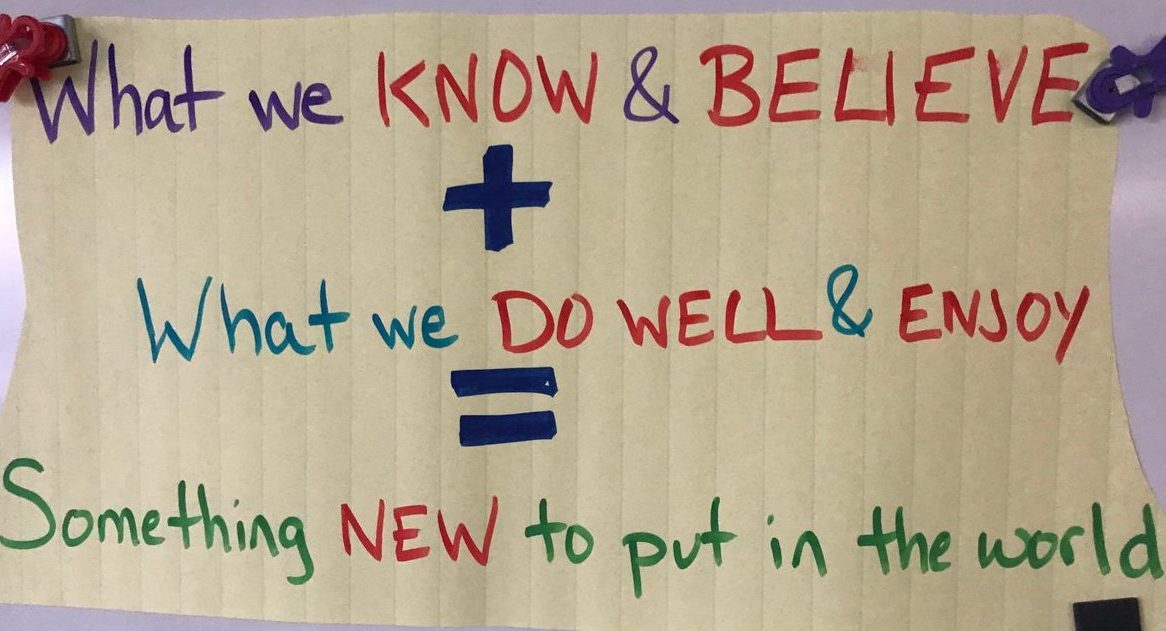
Writing is a path to self-expression for me, yes. But in my students’ eyes, we are cohorts, peers. Writing alongside my students reminds us all that we are learning together, that I have as much to gain from them as they might from me.
Besides. Writing is hard. Crafting something in a genre we’re not comfortable with requires courage. Sharing that writing demands bravery. It’s only fair that I ask the same of myself.
Watching my successes and struggles with writing validates the challenges they face in trying to put something new out into this world. Our shared experiences bring me credibility and respect – neither of which I take lightly.
I’ve gotten such a good thing going with posting online, with writing every day, with cultivating a writing community around me.
It’s made me a better writer. It’s made me more confident. It’s allowed me to shed the yoke of perfectionism that keeps me from putting my work out into the world. It’s allowed me to experience how tough it is to display the sheer courage my young writers demonstrate each and every day, with more grace than I could ever muster.
So for those of you who are regular readers, THANK YOU. You and your work provide me with the inspiration and the motivation to keep putting my own work out into the world.
And yet.
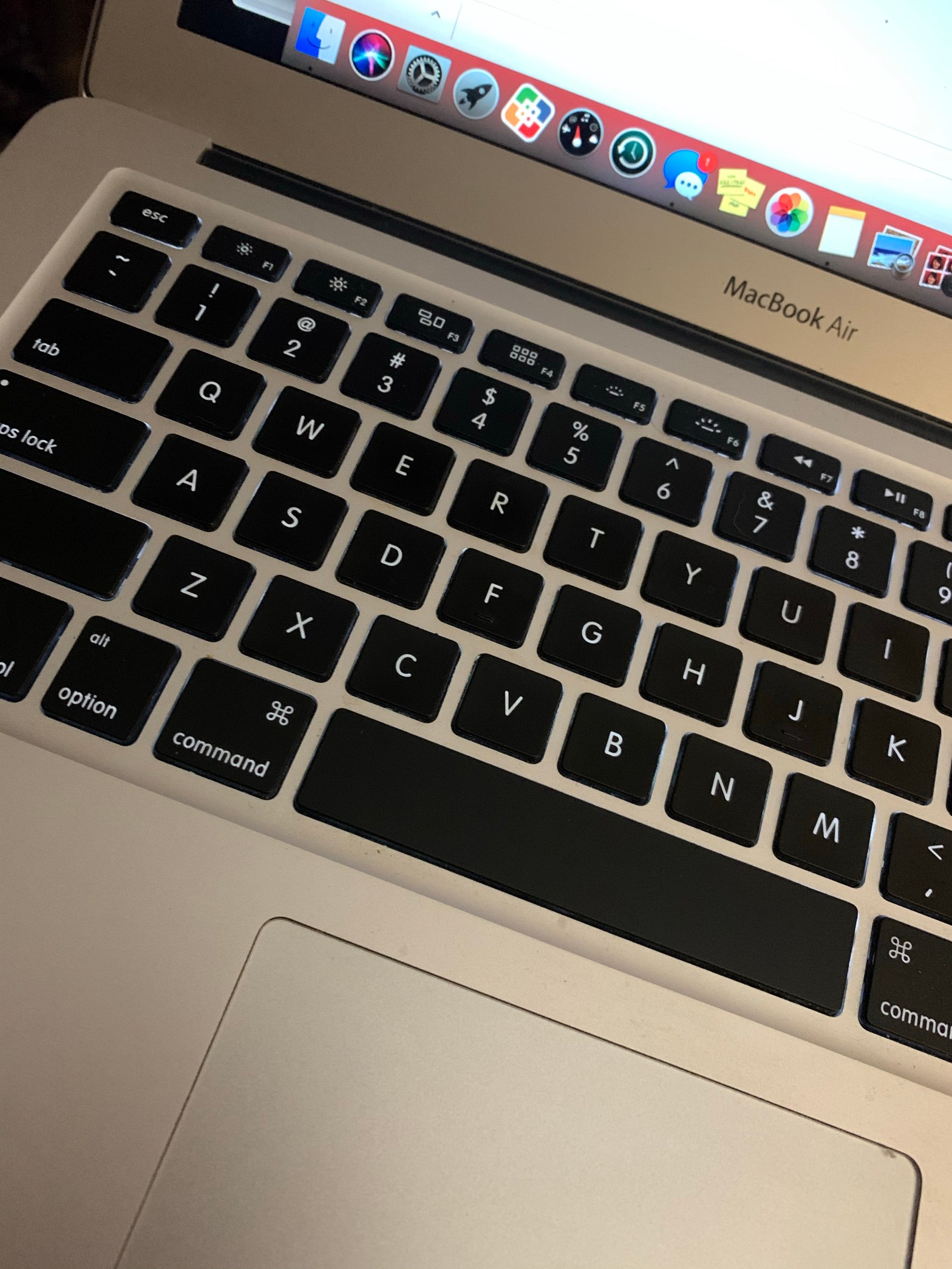
This THING. This contraption that I keep staring and typing into.
My profession right now chains me to this THING.
I spend eight to ten hours a day, sometimes more, weekdays and weekends, in front of this THING.
I go to sleep and wake up with the imprint of a laptop screen in my mind.
And I am not sure how or why I continue to spend more time with this THING than is absolutely necessary.
I’m not sure what this means for my writing right now. Maybe it means that I write by hand for a while, and catch up with blog posts as often as I can. Maybe it means that I grin and bear it, because sometimes writing IS hard.
I’ve just got to figure a way to crawl out from under my resentment of this THING.
So…yes. It’s possible that you might not see posts every single day for a while. But that doesn’t mean I’ve bowed out. If I’ve discovered anything over the last two months, is that I need writing as an outlet.
Because I do not know how to leave well enough alone
Because the shedding of one obligation often just means it is time to don another
And because there will never ever ever be a time when I feel I have done enough when I feel I am enough for my students
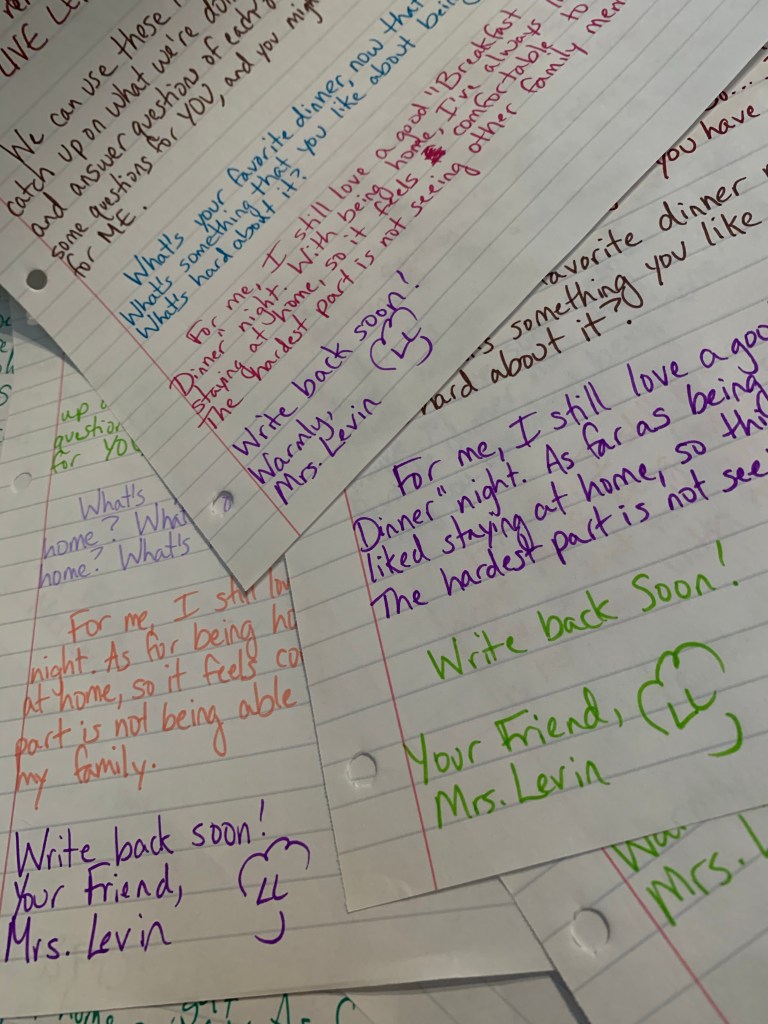
I have begun another venture: offering to be pen pals to those who crave human interaction through REAL LIVE LETTERS in the REAL LIVE MAIL using REAL LIVE HANDWRITING
And I ask how they are doing and what they like for dinner and I ask what they are doing and how they are filling their days
but what I really mean to say is
Here. I want you to have this thing, this thing I made with my hands, this thing that you hold in your hands, this thing that took time and effort and care, and I want you to know you are worth that time and effort and care –
Yes, today I hit “send” on the final term paper of my second graduate school degree. And while I wasn’t originally planning on making it the subject of today’s Slice of Life challenge, I realized that perhaps it was okay to take a moment to celebrate the end of a really, really, REALLY long slog.
And I felt like this poem, and the structure of it, was just enough for me to capture what I’m feeling about it. I’m not jumping up and down in excitement about it, but right now I’d rather offer myself one small corner of satisfaction.





 Soapbox: The Way I see Things