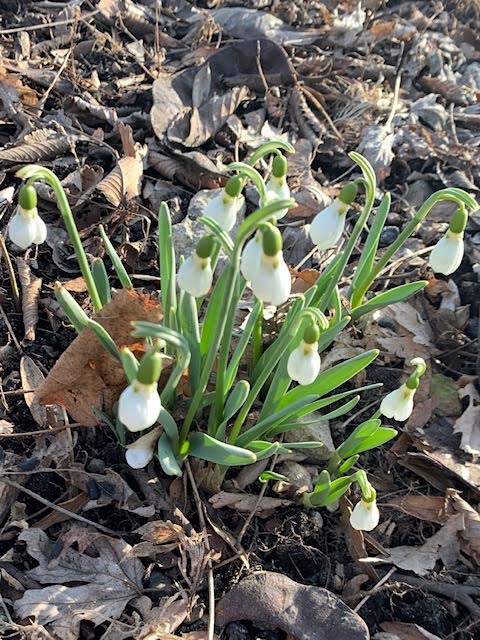
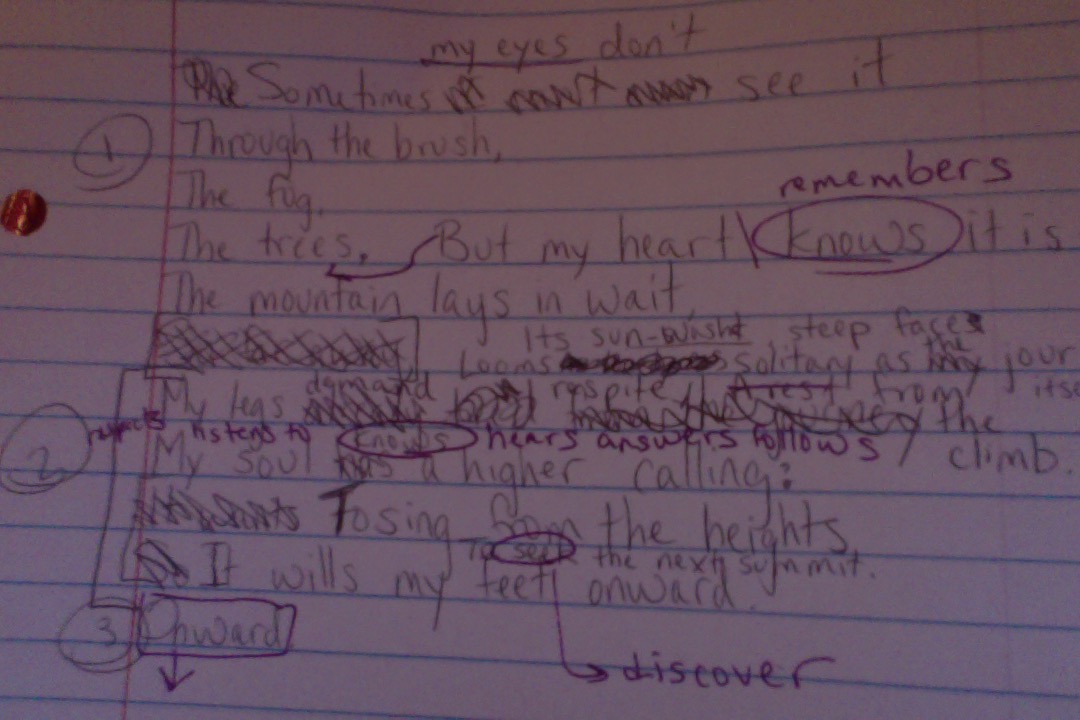
I always love that first day I start to notice signs of spring. Here’s a little old thing I wrote to celebrate.
The sun whispers to the spring soil, “Come out, my friends, it’s Time to play!”
Is it that they don’t hear? Are they still cold, Hiding Waiting afraid for Winter to pass? Who will be the first to break forth? Not the blazing forsythia Nor the big-headed iris Nor the overbearing peony
No.
Only humble crocus, Braver and Stronger Than its delicate petals get Credit for Breaks the silence.
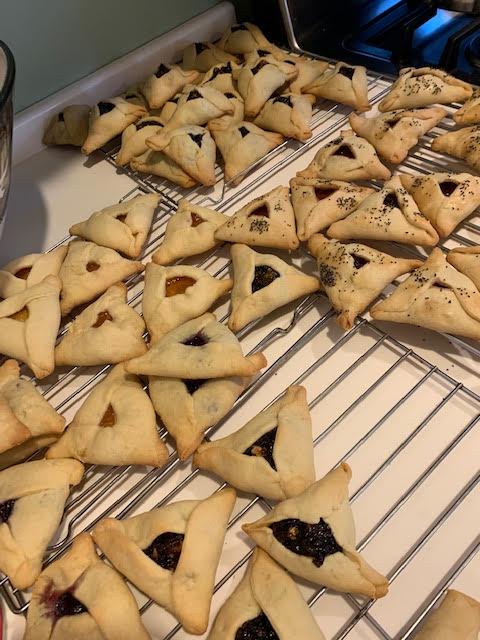
Hamantaschen, for the uninitiated, is a triangular-shaped pastry filled with stuff, and it’s eaten around this time of year in celebration of the Jewish holiday of Purim. Which, for the uninitiated, is a celebration (among way too many) of how someone tried to get rid of Jews and failed.
But in all honesty? That’s not what I commemorate.
For me, it goes back to 1994. I was a student at the University of Illinois when I got a phone call from my best friend from elementary school. Her father, after a brutal fight with cancer, had died.
But before we can get into that, we have to go back to 1984, when she and I were pretty much each other’s only friend in junior high. One of the ways we’d pass the time on our many sleepovers was to bake cookies. Sometimes we’d use a recipe. Sometimes we wouldn’t. Sometimes our efforts would be edible. Sometimes they’d be downright awful. Always we ate them.
So on that February day in ’94, I returned to St. Louis to be with my friend. I wanted to help her just…escape, if only for a little while. Those of you who have been around family in a time of intense grief know that things are just that – intense.
The two of us retreated to my place to make hamentaschen. I don’t remember exactly what we talked about. I don’t remember much. But I do remember that was important time for the two of us.
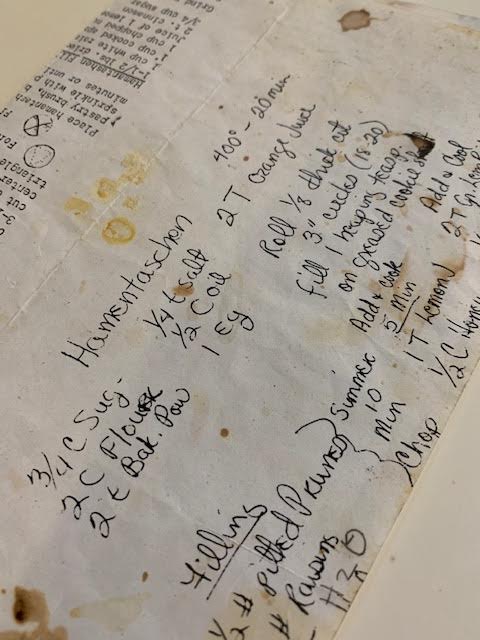
So now, each and every year, when the holiday falls, I once again dig out the recipe, yellowed and food-stained, scrawled in my mother’s handwriting, and I get baking.
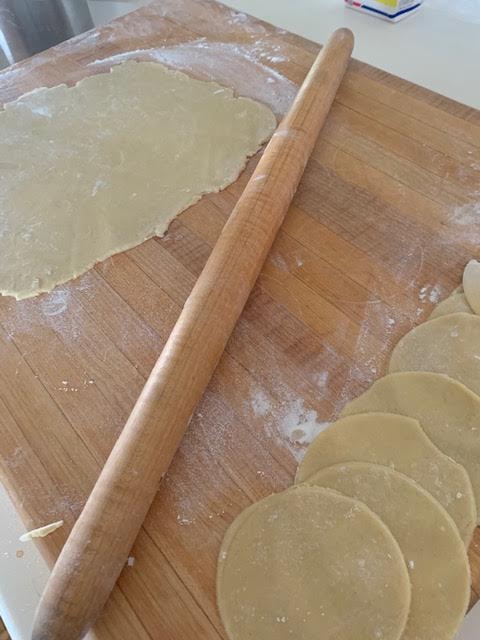
Baking hamentaschen isn’t just a simple mix-it-up-and-throw-it-in-the-oven enterprise. You’ve got to make the dough and chill it before you can handle it.
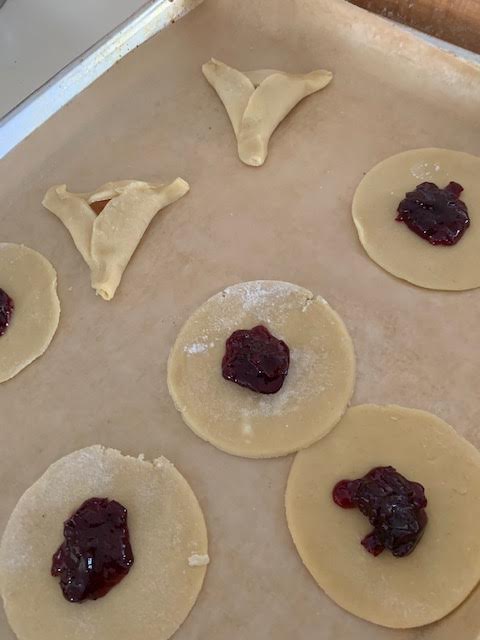
And then there’s the matter of filling. Some folks like to just use canned and jarred fillings – and I kind of do, using whatever fruit preserves sound good as one of my options. But I also treasure my mom’s prune filling recipe. (I know it has the word “prune” in it. Don’t knock it ’til you’ve tried it. It’s one of the most delicious things on this planet.)
So there’s the dough to make. The filling to prepare. And then each round of dough has to be rolled and cut out. Each dollop of filling has to be centered on the dough. Each circle has to be folded into the triangle, pressed down and sealed with egg whites. Then, and only then, can it be baked.
There’s something so very meditative about making hamentaschen, about getting into the rhythm of the filling and the baking, that sends me into a thoughtful mood. I think about what’s going on at school, how my kids are doing, all kinds of odd things.
But I always think about my friend’s dad. I think about what a warm and caring soul he was. How he treated me like one of his own kids. How he was always up for anything. How he was one of the funniest people I knew. How very much he loved his family. How very much my friend loved HIM.
Today’s lesson was a lesson in…what should I call it? Patience? Self-forgiveness? Understanding? Revised expectations?
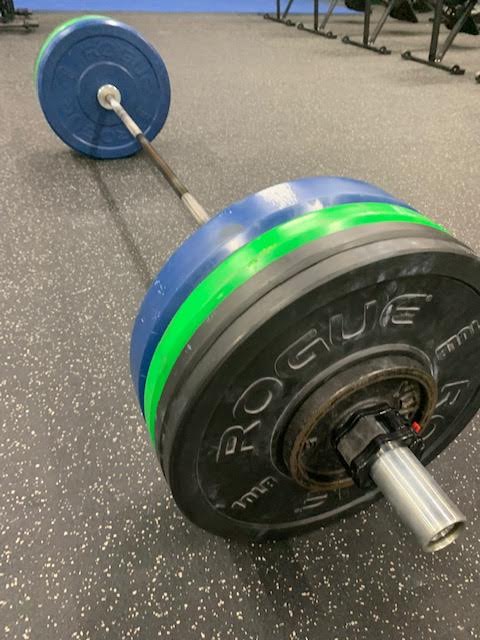
I went to the gym today hoping to score a new PR (personal record) on my deadlift.
Yeah, I guess that makes me a meathead. I’ll take it.
I really wanted this one for a friend of mine, who’s been ill and going through a LOT of tough stuff. We started at my gym around the same time, and we would always joke around about how regularly – and badly!- she would kick my behind.
Now, though, she’s not allowed to lift weights. Like, not ever again. How does a 30-year-old carry that news? I can’t imagine.
So now? Now we joke around about how I’m sneaking up on her old PR’s. And the biggest one is the deadlift. As of last spring, I was 5 pounds shy of her best lift.
Today was my day to test it out. Today I wanted catch up, and to send her a video of me celebrating, and to let her celebrate along with me.
I arrived at the gym to work, and the first several sets working up my weight felt great. I built up the barbell, confident that things were going great.
And then, they weren’t.
25 pounds below my target, I stalled. I tried three times at that weight, and NOTHING DOING. In gymspeak they call that failure. My great hope for today clearly wasn’t happening.
Yes, I was discouraged. Yes, I was disheartened.
But I am also grateful to myself. I have now lifted long enough to know that there are some days I’ll have great lifts, and there are some days I’ll fail. And failure simply means it didn’t work this time. I’ve worked to be strong, and no one can take that away.
So I’ll be back at the gym soon enough, plowing ahead with whatever it is that’s next.
And as for my friend? Ohhh, I’ll catch her. One day.
Each week, I ask my writers to set an intention for the following week, and to let me know what, if any, support they might need. One of my kids asked me for some support on how to make her characters more complicated.
Well, this fourth grader also happens to be an incredible writer. As in, I wish I could employ the craft of narrative with the skill that she does. So before I rolled out all my resources I thought I’d just ask her. “What, in your mind, is a complicated character? What does that look like?”
That gave her some pause. She thought a moment, but still couldn’t come up with anything. So I asked from a different direction.
“Like, sometimes when we think about complicated or complex characters, it’s because we don’t always know what to think about them. Sometimes they say or do things that we might disagree with, and we’re not quite sure what to do with that.”
She thought more about that one. I think I was starting to get through.
I went on. “You know, we don’t always have to like the characters we interact with. But sometimes we might grow to like them as they change.”
So then she told me about the character she’s trying to create, one who had lost family members.
“Oh. Grief does make people do kind of weird things. Maybe then, this is a person who’s angry? Who does mean things to push others away?”
That seemed to get some traction. I decided to level with her.
“So…you’re a nice person. As another nice person, I think I can talk about this with you. Do you ever have times where you think about saying something mean, or you think about doing something mean, but you don’t because you’re a nice person?”
THAT got a nod. I knew it would. I know, because I’m a fellow nice person. I continued.
“So maybe this character will give you a chance to explore what it’s like to be that person who says and does the mean things that you never would. What do you think?”
And guess what? She’s going to take the leap! I told her I was pretty excited for her, and I think she may be pretty excited for her too. I also told her she’d be the inspiration for today’s slice. And at some point, I’ll let my nice-gal reputation slough off for long enough to create a mean ole character of my own.
Lainie drew a breath, huffed it out and rubbed her face with her hands. “But I don’t actually want to,” she whined. “Can’t I just…you know…write some poetry or personal narrative? I’m sure it will turn out much better for all involved.”
Her friend pursed her lips, then caught herself before snapping back. She paused a beat, then asked, “What’s that you always say to your students? That you DON’T have to like everything you write?”
“Oh, THAT’S unfair. Throwing my own words back at me. Niiiiice.” Lainie scooted her chair back, closed the laptop and jammed it into her bag. “I don’t have time for this.”
“Hey! Aren’t you the one who’s all, like, ‘Be brave!’ and ‘Push your thinking’ and all of that nonsense? Where does that go for you?” cried the friend.
“I said it worked for writers, but that doesn’t mean I want to do it,” Lainie retorted. “Quite frankly, I’m just not comfortable writing narrative fiction. It’s kind of like sardines. I’ve tried it enough times to know that I don’t like it. And I’m the grown-up. I should be able to like what I like and be okay with it.” Lainie slung her bag over her shoulder and turned to the door.
“Hold up, hold up,” the friend cajoled. “Yes, you are most assuredly a grown-up. And yes, you are most welcome to have your own opinions. But I’m not the one who has to face your students and tell them you were a scaredy-pants.”
A silence, thick like resentment, settled in the space between them.
Lainie dropped her bag and eyed her companion. “Say that again.”
Her friend, undaunted, met her glare. “I. Said. You were a SCAREDY-PANTS.”
Rolling her eyes, Lainie said, “I thought that’s what you said. You can’t make me write narrative fiction. Nobody can. Nobody will. It’s nothing to do with scaredy pants or shirts or scaredy anything. So there. I’m not writing narrative fiction.”
Story shrugged and sighed. “Suit yourself.” She made her way out the door, but not before delivering a final smirk over her shoulder.
There it was, glistening like a coin dropped to the bottom of a pool.
She glanced down and shrugged her shoulders – probably not worth the effort to pick up. I mean, she thought, after all, she considered, what on earth, she pondered, would I even do with it?
She thought a moment at this prize, this gift that lay before her, if only she would take it for herself. Oh heavens, she mused, I’ll probably regret not grabbing this, won’t I.
She fixed her gaze, held her breath, and dove.
Coming up for air, she contemplated what she now held:
Today begins a commitment to thirty-one days of writing. Thirty-one days of stories from my life, from school, that I am putting out into the world.
It makes me think about stories, and how very much I talk and think about them. I carry them with me, and I encourage my students to do the same. Stories are wonderfully portable. We can roll them up into a ball and stick them behind our ears, shove them in our pockets, slide them into our shoes and carry them home so we can pull them out later, stretch them out and give them some air. This is especially helpful when we hear a great story and want to keep it for ourselves, or when the idea strikes us for a story at a random time.
But sometimes, stories hide from us. We sit expectantly, pencil in hand, or fingers on the keyboard, and nothing pours out. The wait becomes discouraging. Frustrating. Maddening.
What’s hard, then, is knowing that a story doesn’t hide from us because we’re poor writers, or because we have nothing to say.
What’s hard is knowing that sometimes a story isn’t working out because it’s just simply not ready to be told. That it needs to wait until the time is right. That it’s not about us. Sometimes, just sometimes, a story isn’t ready for us. But don’t worry. It’s there, hanging out, just waiting for the right time to make an appearance. And then, if we are meant to tell that story, that story will offer its words.
What’s hardest is teaching this lesson to my young writers. To teach them that perhaps the reason why words and ideas sometimes escape us, and perhaps the reason stories refuse to come together is that THEY are not ready for US, and not the reverse.
It is not our failure as writers that we get stuck. It is not a shortcoming to feel an absence of words. Rather, we can take it as a sign nudging us in a different direction.
Today, I think I got lucky. Words came to me for this post, and for that I’m grateful. I’ve got a lot of other writing I need to accomplish today, and I can only hope the words continue to be as kind.
This month, I’m not sure which stories will come tap me on my shoulder, will come pull my sleeve, demanding for me to tell them. I’m not sure which ones will peek around the corner and beckon me with a wave before scuttling off, giggling, into the distance.
I guess we’ll find out. Thanks for taking this journey with me.
If you had asked me today whether or not writing poetry should be on my to-do list, I might have laughed at you. But knowing that the universe has a way of conspiring, and knowing that grocery list poetry is a thing in this world, I felt compelled. What I loved were the ways this poem unfolded and surprised me in ways I didn’t quite expect. Enjoy.
Poetry, Found
In the way-too-early morning, In my hurry out the door Obligations (too many for my own good) Slung from my shoulders, my back – I catch, among the rocks, Someone’s grocery list Delivered to my doorstep, And I wonder: -Whose list is this? -Did they ever get their pancetta? -Do they always cook like that? -Or is it for company? -And can I be invited? -Is it true what they say, that there is poetry in lists? -And why did this one find me? -Did it blow out an open car window, On a warm February day, Unexpected? -Did it slip from the wallet of a grown-up, Anxious to get going? -Is anyone missing it? -How do they know what they’ve got? -How do they know what they need? -And how many things Flutter away With no one to feel their loss?
“So, Lainie. How do you know you’re working with gifted kids?”
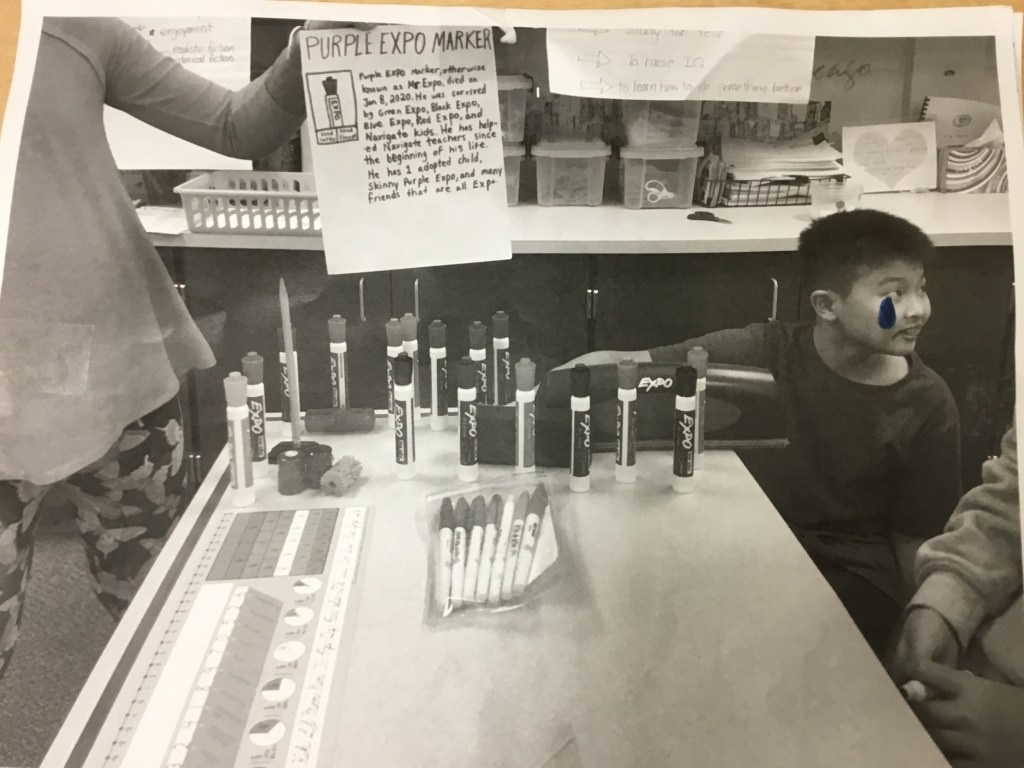
I present to you an obituary for…wait for it…
an EXPO marker.
Note the many fine text features, accurately applied
People, I can’t make this stuff up.
Earlier this week, we read Leo Lionni’s obituary to learn more about him as an artist and as a person. To understand that text, we had to discuss what exactly an obituary is. It just so happened that day we had to deep-six an EXPO marker that had gone south.
Today, my kiddos surprised me with the above gem. What do I love so very much about this? How do I know my fourth graders have already won 2020?
For starters, they’re completely true to form. I mean, c’mon. After a single day of exposure, they included the ACTUAL TEXT FEATURES of an obit:
“Photos” of the deceased
*”Send flowers/Send a letter”
*Information about his life
*”He was survived by”
And did you catch the “skinny purple” adopted child?
Or maybe you’d like to see how the “funeral” went down:
Please note the crocodile tear sketched in to the photo
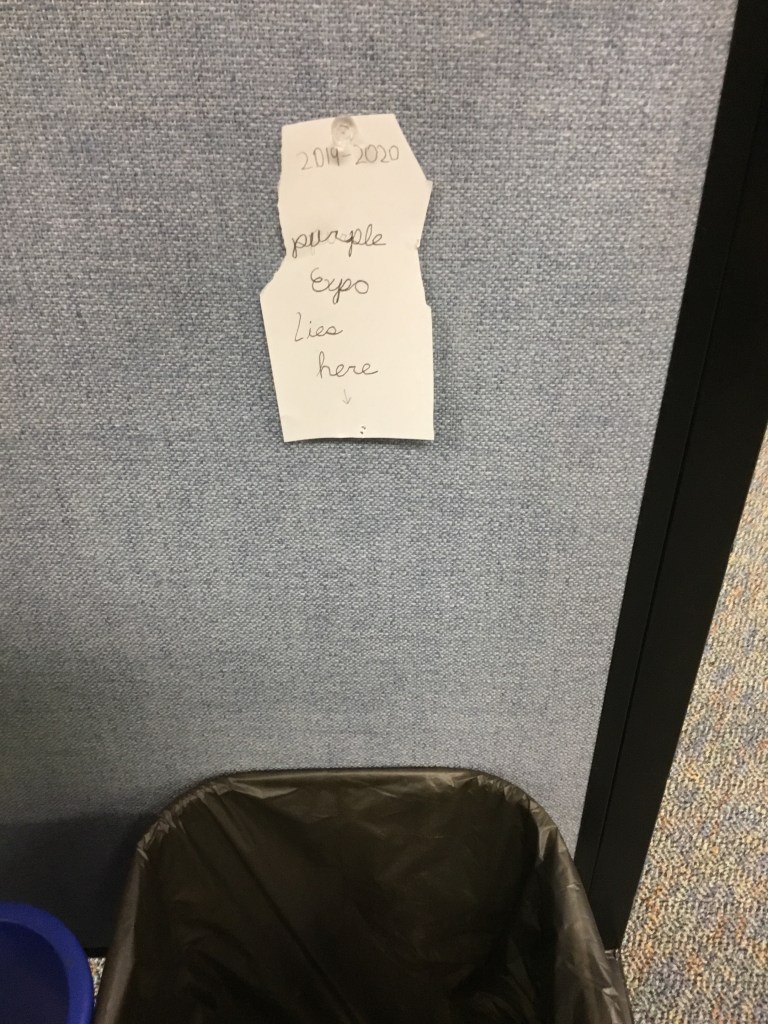
Or, if you are in our classroom, you’d like to visit poor Purple Expo’s grave:
Alas, Poor Expo! We knew him…
Days like these, I am immeasurably grateful for my students.
Know who else I’m grateful for?
Their homeroom teacher.
Their classroom teacher actually allowed all of these hijinks to take place, trusting her instincts that they were up to something interesting. She is the one who knew that even though the kids were a little noisy, even though the kids were a little giggly, even though the kids were a little silly, that they were up to something good.
We know they were.
And stuff like this is 100% worth the price of admission.



 Soapbox: The Way I see Things