Steering My Craft: Sound of Words Part 2

This blog post is part of an effort to refine my own work as a writer. For each exercise, I’ll provide the directions, my effort, and a short reflection.

The Assignment: Write a(nother) passage that wants to be read aloud, this one dealing with a particular action, feeling, or emotion. Here’s where I landed:

Yes.
Please.
Thank you.
Tight words, terse voice, hunched shoulders, a tightrope walk of everyday actions and interactions carefully strung together: brow set, breath held, until-

Until alone, when the pin pricks begin, poking, pulling, needling, loosening, then unraveling the grief that has wrapped, spooled, tangled and knotted itself in and around her heart. She senses a slackening, and before she can catch the strings they have spun out and away, leaving her naked, open, in a shuddering, deepening darkness.

It is there she sits until she is ready to gather threads, knit herself back together and back into the world.

My Reflection: Grief always seems to follow me, nosing its way into my writing. Even though the topic itself is a weighty one, I had fun with this exercise, and I like how the imagery of knitting came up as I was working.

Steering My Craft: Exercise 1-The Sound of Words

This blog post is part of an effort to refine my own work as a writer. For each exercise, I’ll provide the directions, my effort, and a short reflection.

The Assignment: To craft a short passage that asks to be read aloud. The object is to have fun playing with words and their sounds. Here’s what I came up with:

She stepped off the ship and drank of the air. Not the polite, genteel sips of a carefully-poured glass of wine, but the deep, full-thirsted gulps of clear, teeth-chilling water. Filling her lungs full, fuller, fuller, she began to wonder when she had last truly breathed, or if she had truly breathed, or when her lungs had last known how joyous it was to quench their thirst. Or…had they ever?

My Reflection: I enjoyed this exercise, and I think I crafted a passage that uses the sound of language well. At least, I know that I can hear the words when I write them, and I do enjoy reading it aloud. Did I go so far as to play with words? Mmmm…I’m thinking I may have stopped short there. Perhaps I’ll revisit this one with more of a playful eye – and ear.

Steering my Craft: Ground Rules

I’m excited to spend time working on my own writing over the next several weeks in the hope of becoming a stronger writer. But I won’t lie. The task is daunting, and I’ll have to face my demons.

Perfectionism: I get so caught up in my ideal vision that I either won’t begin, or I’ll mire myself too deeply in self-doubt and revision. That, or I’ll chicken out before sharing because my inner voice is a jerk. C’mon. Nobody wants to read that stuff.

Shiny Toy Syndrome: When I was a Campfire Girl, I had to recite the Bluebird Pledge. The hardest promise? “To remember to finish what I begin.” It’s easy to get on a kick, but it’s harder to maintain the discipline to see it through, especially when things get tough.

Self-Worth: As a mom, teacher and grad student, it’s easy to let other roles and obligations overshadow my own personal development. So when I do have time and mental space, it’s easy to sit back with a book, or to catch up on dumb TV, or scroll through a Twitter feed because I’m not obligated to anyone. Trick is, that leaves me. I need to honor my obligation to me.

So, as I begin, here’s how I’m going battle these demons. My plan:
1. Write something every day. Even if I don’t like what I write.
2. Complete exercises from the book at least 2 times a week.
3. Avoid revising the exercises, unless it’s called for. (This one will be difficult. I’ve already revised this post four times.)
4. Share all of my exercises, even if I don’t like what I wrote.

<<inhales>>
<<exhales>>
<<dips toe into water>>
<<shivers>>
<<shrugs>>
<<holds breath>>
<<leaps>>

Steering My Craft

I’ve long had a resistance to writing fiction. I’m not quite sure what it is, but perhaps it’s because it’s like art in many ways. I might see a horse in my head, but I can’t get myself to produce what I see. Similarly, I can’t get myself to create fiction that matches the movie I see in my head.

As a writing teacher, I carry a lot of guilt about this. I’ve been trying to write alongside of my students, to go through the process that they do. It helps me understand the magnitude of what I’d really asking them to do. Plus, I’m not going to lie. It gives me a bit of street cred when they see I can write too.

It’s so easy when we’re working on personal narrative or poetry. And I can pre-write fiction with the best of them. But when my kids launch full-on into their stories? They leave me in the dust, marveling at their fearlessness.

I’m determined to make this the year that I draw upon my students’ courage and challenge myself more fully as a writer. It’s time to get brave.

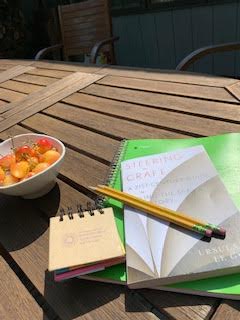
This summer, I’ve committed to improving my own writing through the exercises set forth in Ursula K. LeGuin’s Steering the Craft: A 21st Century Guide to Sailing the Sea of Story. * I’ll be posting my experiments in this blog, and I’ll hopefully use my learning with my students.

I welcome any feedback. And, if you’re up for writing along with me, send me a link to your work. I’d love to read it!

Bon Voyage.

©Lainie Levin, 2019

*Thanks, storyteller extraordinaire Sue Black, for the original inspiration to take up this challenge.

Summer Dreams

This post is in response to a bookcampPD challenge, asking teachers to think about what they dream about for the summer. Here was my submission. I can’t wait to see what my online colleagues have to say as well!

…and you…? I’d love to know what you dream of doing this summer. Leave a comment and let me know!

*******

This summer, I dream of doing more. More “less.”

Let me explain.

Throughout the school year, I pack all of the “more” I can into my days. Between planning, grading, kid logistics, managing a household and trying to maintain some semblance of self-care, I find myself crammed in with little room to breathe.

I used to feel obligated to be productive with my summers, so that when people asked me what my plans were, I would have an answer that sounded important and busy: graduate work, professional development, curriculum planning.

Don’t get me wrong, I still continue much of that over the summer. I don’t think it’s ever possible to completely shut off my teacher brain. But I’m also realizing that I don’t have to feel guilty for having times where I am unproductive. Simply put, I need to come up for air. And summer is the time to do it.

And if that means I do less? So be it. I’m owning it.

This summer, I dream of doing less of my “more,” and more of my “less.”

More hiking and walking.
More reading.
More baking.
More working out.
More sleeping.
More catching up with friends.

And when I come back to school in the fall, there will once again be more of me to go around.

When Poems Find Me

Sometimes a poem strikes me, and I’m able to write it in the moment. I get an idea for an image, a phrase or a metaphor, and I just can’t help myself.

Other poems are more coy. They want me to write them, but maybe I have too much to say and don’t know how to squish it all down. Or maybe I feel too strongly and the words haven’t quite yet translated.

I’ve been trying to write this poem for about three years now. It surfaces each time I ask my fourth graders to personify an attribute or emotion. I keep wanting to write this poem, but it’s eluded me. It doesn’t help that this assignment comes around the same time of year I lost my brother, and writing about grief while I’m feeling it is…well…messy.

This year, for whatever reason, this incredibly patient poem decided it was time. Enough with the nonsense. Just write already. So I wrote. Here goes:

Grief

I am Grief.
We may not
Yet
Be familiar.
But we will,
Some day.

When we first meet, I am
Everywhere,
Awaiting you in moments
Large and small.
I hold you tight enough
To steal your breath.
Or hide behind a corner
Waiting to spring you
In the off-chance you have forgotten me.

People know me by
That tell-tale dimple on the cheek
That one song that comes on the radio
The telephone call you go to make before realizing
You can’t.

People never consider
How attached I am
To Love.
But there we are,
Always intertwined
As best friends are.

People never consider
I am not one to be escaped
I am not one who should be escaped.
I want to whisper,

Come.
Sit with me.
Let me surround you,
Enfold you.
I am here, yes.
And so is Love.
As you sit,
And as you sink,
You might just fall.

Let us catch you.

-© Lainie Levin, April 2019

Troubleshooting: Questions Edition

It started out easy enough.

My second graders were sharing the questions they had written with one another, and to promote supportive listening I had the kids nominate strong questions for a light-hearted “awards” ceremony.

Our “Questies” consisted of 3 categories:
*Questions we’re most curious to find the answer to
*Big questions, that nobody really has the answers to
*Questions we’re jealous of because we wish we had asked them ourselves

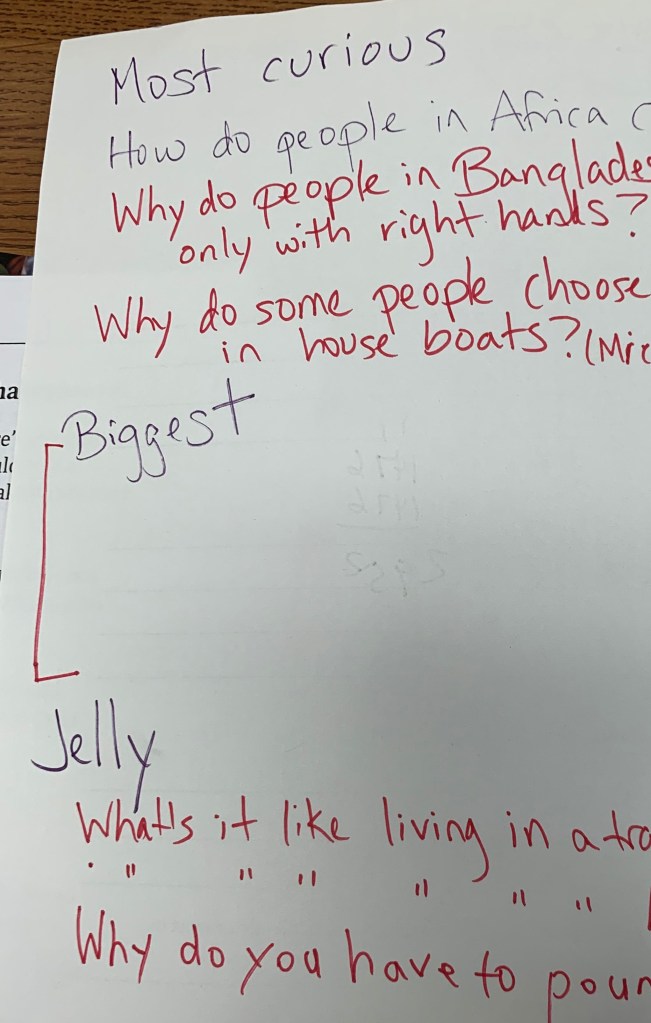
I solicited nominations, and it went well. At least…in TWO of the three categories. See for yourself:

We knew which questions we were jealous of, or curious about, but we just couldn’t seem to nominate any big questions. Which means a few things might be happening:
*None of the kids wrote any big questions on their homework.
*The kids weren’t listening to one another as well as they could have.
*The kids don’t know what a big question is.

Situations like this always present themselves like a choose-your-own-adventure story. I’ll have to start by diagnosing the homework assignments. If there are several “big” questions on there, it looks like we’ll have to do some activities on how to be a listener.

If there aren’t any “big” questions on there, I’ll have to figure out if it’s because kids weren’t giving their full effort, because they’re not connecting deeply with the reading, or because I need to do some teaching on what big questions actually are, or how to ask them.

I do know that, as a teacher, I do this kind of problem-solving every day. Multiple times a day. Sometimes in bigger ways like this, that make me stop and think. But most of the time, I’m performing dozens of these calculations without even noticing.

And what will the answer be to THIS question? What will be the diagnosis of my “Question” question?

Only time – and a bit of investigation – will tell.

March: Blowing in Like a Poem

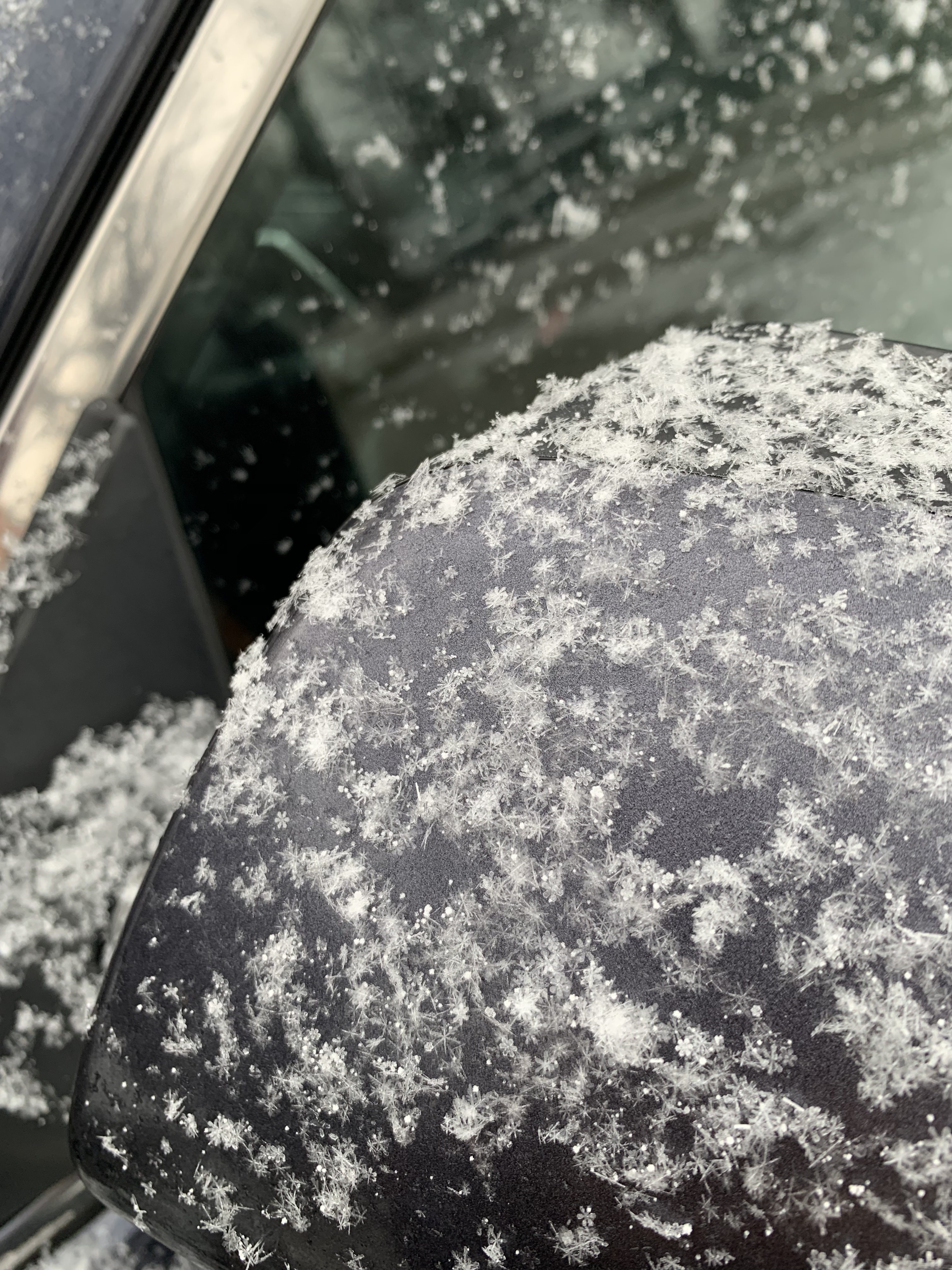
So many little miracles happened for me today. I got a hug from a reserved second grader. A tricky third grade class was beautifully behaved. And this morning the world brought me a seed for a poem, which I carried in my pocket and thought about through the morning. And when my fifth graders held their Freelance Friday writing time, I joined in the fun. Here’s what I wrote.

To Today’s Snow, Who Surprised Me This Morning On My Way To Work

I feel sorry for you
For coming on Friday
In March
When we were cold, and tired,
And tired
Of being cold, and tired
And people huffed past you
Without a glance,
Wishing you had been sunlight.

If only
You had arrived in October
We would have greeted you
In wonder.

If only
You had arrived in October
I would have gathered my class
To run outside,
Black paper
And magnifiers in hand.
And we would have seen you,
Really seen you
Marveling at your structure
And intricate detail.
There would have been squeals
As we caught you on our tongues
And you stuck
To our eyelashes,
Our hair,
Our not-ready-for-winter clothing.

But it is March.

So I hope it is enough
That I saw you today,
That I noticed
The delicate fluff
Of sparkle
You laid upon the world,
And that I spent a wistful moment

Before snapping a photo,
Starting the car,
Turning on the wipers
And pulling away.

(c) Lainie Levin, March 2019

Making Lemonade

Now is about the time of year when I give my fifth grade students an assessment on literary analysis. We have spent a fair amount of class time learning how to write proper claims and arguments, and we have also discussed the type of language that is best suited for the tone of academic writing.

These essays are part of my year-long data gathering; I use these to determine growth among my students across the year. So when I look at their work, I’m hoping to see kids using the structure and conventions I’ve taught them.

It is so very hard to be patient.

It is so very hard to look at these novice, rough-around-the-edges attempts with a generous eye.

It is so very hard to look at where the kids are now, and not be so very discouraged about how very far we must go from here. To not look at the papers and give up because it all feels like one hot mess.

I knew that if I sat down now to fill out the rubrics on their writing, it would just make me crabby. Everyone knows they don’t want a crabby teacher evaluating their work.

So, I decided to hit the brakes for a bit and get the students involved. I had them read their work aloud to themselves to get a feel for how it “sounded” to them.

IMG_A6D39B36AFC0-1

Then, I asked them to choose a recent work to compare to their beginning of the year writing, and reflect from there. The questions were:
-When you compare your work from the beginning of the year until now, what strikes you or surprises you?
-In what areas have you seen the most growth in your writing?
-Looking at the most recent essay, what areas do you see yourself needing to improve or strengthen? What skills do you need to learn?

Lo and behold, as they do just about every time, my students came through. The level of thoughtfulness and insight that the kids brought to their responses was encouraging and refreshing. Just as I had hoped, their reflections on growth reminded me that indeed, their writing has come a long way since the beginning of October. Much to my relief, many of their areas for improvement were the same as what I would have suggested.

In a busy and stressful time of year, this activity was a reminder to listen to my loveys, to allow them the opportunity to reflect, and to celebrate their growth and development.

Quite the holiday gift.

On Teaching and Transparency

I’m always complaining that I don’t have enough mentor texts to teach my students about reading and writing concepts. I can never get enough. That’s why I was so excited to introduce a concept to my two fourth grade groups yesterday and today.

I got the idea from Kristin Ackerman and Jennifer McDonough’s book, Conferring with Young Writers: What to Do When You Don’t Know What to Do.  They suggested creating reference books to teach writers about skills and strategies they can use in their work. Want to learn more about personification? Find the reference book to see multiple examples, then give it a go in your own writing.

Over the coming weeks, my students will mine both their favorite books and their own writing for mentor texts to create these resources, and they are as excited about the proposition as I am.

But that’s not what my post is about. Sorry to disappoint.

Here’s the thing.

The top of the student form reads, “Mentor text submitted by______.” As soon as I passed the papers out, a student asked, “What’s a mentor text?”

What’s a mentor text?

What’s a MENTOR TEXT?

You mean, that thing that I use nearly every. freaking. DAY in the classroom to teach you reading and writing skills? And agonize over how I will find more? And more quality ones? And plan nearly every. freaking. LESSON. Around?

You don’t know what a mentor text is?

The answer was no. Not one of the nearly 20 fourth grade students had any clue.

And I thought, how is that even possible? How is it possible that there is something so incredibly integral, so incredibly critical to what I teach, yet my students do not even know what I’m talking about?

To say it was eye-opening was an understatement.

I’ve done a bit of thinking since then, and here’s what I’ve come up with.

There is a lot of teacher language that my colleagues and I use. We use a lot of technical vocabulary around reading, around writing, or behavior, or learning. What is stopping me from using that language around my students? What stops me from calling things what they actually are?

Frankly, I’m not sure that anything really is.

I’m not entirely sure where this will all lead, but there is one thing I know for certain. As a teacher, I need to think deliberately and with intention about the language I use. If I want my students to use the language of craft, and the language of learning, I have to make sure that I am open and clear with them about what I’m doing, and how I’m teaching.

My students DO know what a mentor text is now. At least they’d better, because it came up at least eighteen more times in our conversation. But my other blind spots? The other assumptions I’m making about their knowledge or vocabulary?

My guess is, if I’m becoming more transparent in my teaching, those are going to come up soon enough.

They will have to.