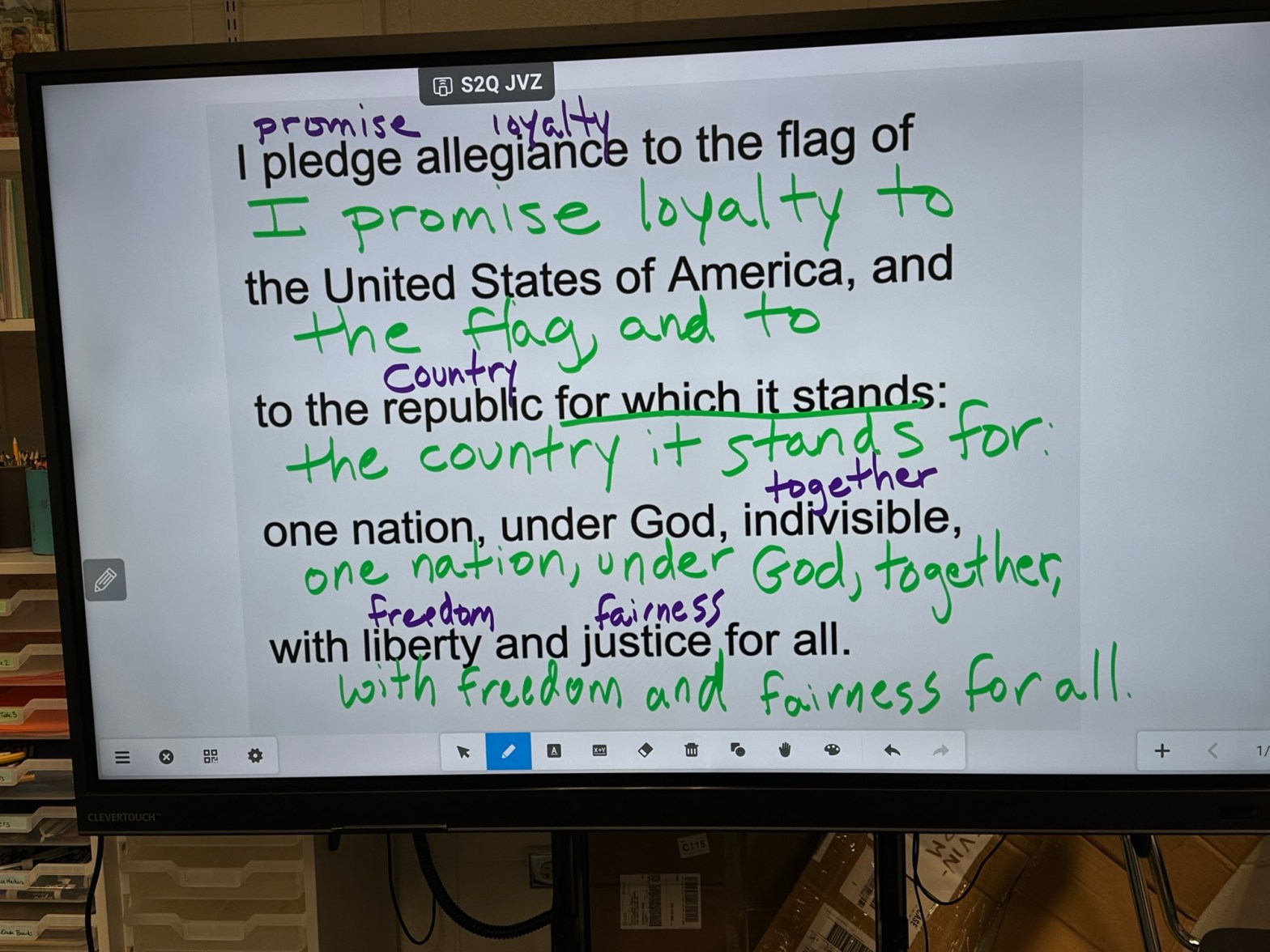
Today I had my students “translate” the Pledge of Allegiance into fifth-grade language. It was an exercise in:
-Using the online dictionary
-Simplifying words by thinking, “That’s a fancy way of saying ______”
-Learning how syntax (word order) affects the tone of writing
-The benefits of simple clear language
Oh. And.
-We’ve been saying this thing for how many years without understanding it?
-We’re saying it to a flag.
-Which symbolizes our nation.
-Freedom.
-Fairness.
-For ALL.
 Soapbox: The Way I see Things
I love that you encourage your students to really understand what they’re saying! A lot of times the Pledge becomes just another routine, so I think this is so important for kids to learn about and remember. Great job!
Happy to find your post in my reader today. Really love the visual product of your slice. Also a great lesson on paraphrasing! Thank you for sharing!
Thanks! It’s good to see you back here this March!
I’m doing this lesson again with a different group of students. We’ll see what the conversation brings…
Oh, this leaves me with feelings, too. I’m glad you shared the visual of their “translation” and goodness, I love your final lines of your Slice: Freedom. Fairness. For ALL. (I’m a little bit afraid of the reasons why “under God” got added to the pledge – thanks to your post, I just learned that important history lesson!)
Yes, my kids learned that about that “under God” part in this exercise as well. Which is interesting, because we’ve read allegories about the Cold War – this is a chance for them to see something concrete and lasting that came as an effect…
I appreciate you sharing this exercise. Reciting the pledge is a practice, I suppose, meant to be taken for granted. Having students look at the language carefully and consider its meaning is certainly a very useful habit to build.
Agreed! When you talk about reciting the pledge as a practice taken for granted, it reminds me of some of the prayers in the Jewish tradition – they’re meant to be recited rote, without a lot of thought, because it actually creates space for the brain to wander around the bigger ideas of it.
What a great exercise to get kids thinking and to something we say in meaningful (to them as well as others) language.